Unleashing the Super Agent Harness: A Deep Dive into Bytedance's DeerFlow
Discover how DeerFlow 2.0 transforms from a deep research tool into a full-fledged agent harness with sandboxing, sub-agents, and persistent memory.

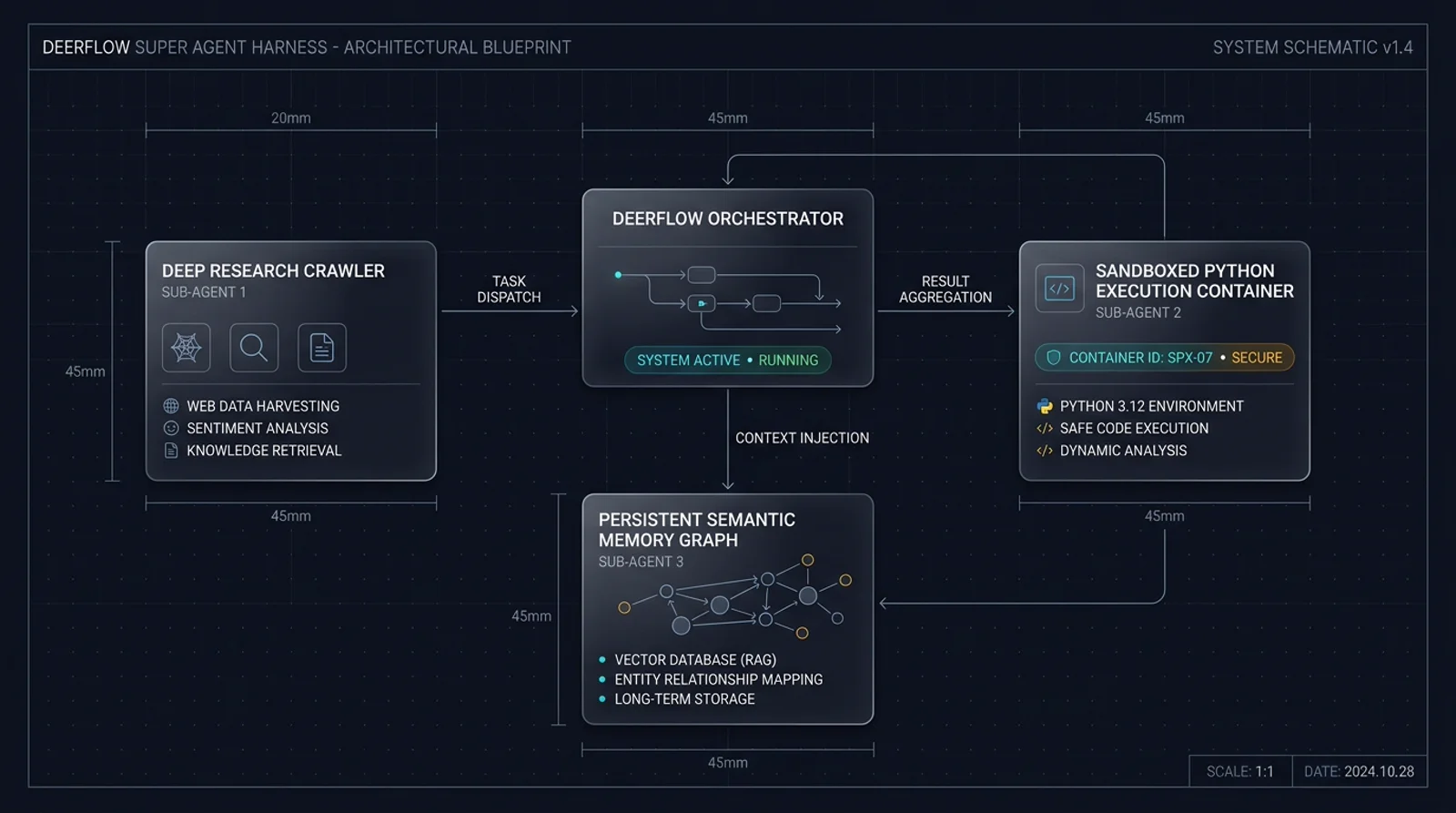
Part 1: Foundations (The Mental Model)
If traditional autonomous agents are like lone freelancers trying to balance every task in their heads, DeerFlow is an entire corporate office.
Developed by Bytedance, DeerFlow (Deep Exploration and Efficient Research Flow) started as a Deep Research framework but has evolved into an open-source super agent harness. The mental model here is an Orchestration Runtime. Instead of just wiring LLM calls together, DeerFlow provides the actual infrastructure - a sandbox, a filesystem, memory, and a sub-agent execution engine - so AI can do real work securely.
Part 2: The Investigation
DeerFlow 2.0 is a ground-up rewrite built entirely on LangGraph and LangChain. Its architecture introduces five major pillars that differentiate it from standard agent frameworks:
- Sandboxed Execution: Agents aren’t just reasoning; they have their own computer. Every task runs in an isolated Docker container with a real filesystem and bash access.
- Sub-Agent Swarms: A lead agent can dynamically spawn constrained sub-agents for parallel tasks, synthesizing their outputs at the end.
- Progressive Skill Loading: Skills (like web search, image generation, or custom Markdown workflows) are loaded into the context window only when needed.
- Context Engineering: DeerFlow aggressively manages tokens by summarizing completed tasks and offloading intermediate results to the filesystem.
- Persistent Memory: It builds a long-term profile of your preferences across sessions.
Part 3: The Diagnosis
For developers, especially Python engineers, DeerFlow is a paradigm shift. It elevates you from writing prompts to building extensible capabilities via MCP (Model Context Protocol) servers and Python functions.
The Embedded Python Client
You don’t have to use the web interface. DeerFlow ships with a robust DeerFlowClient that gives you direct in-process access to the entire agent harness:
from src.client import DeerFlowClient

client = DeerFlowClient()

# Initiate a task and spawn the harness
response = client.chat("Analyze this repository and generate a slide deck", thread_id="research-thread")

# Stream responses natively utilizing LangGraph SSE protocol
for event in client.stream("hello"):
    if event.type == "messages-tuple" and event.data.get("type") == "ai":
        print(event.data["content"])

# Progressively update skills on the fly
client.update_skill("web-search", enabled=True)
client.upload_files("research-thread", ["./architecture.pdf"])
Real Use-Case: The Ultimate Researcher
Imagine needing a deep-dive analysis of a competitor’s product. With DeerFlow, the lead agent spawns three sub-agents: one to scrape the competitor’s docs, one to analyze public GitHub repos, and one to search forums. While they execute in parallel, a fourth agent uses an embedded Python skill to generate a PowerPoint (.pptx) report on the isolated Docker filesystem and returns the deliverable.
Part 4: The Resolution
Getting started with DeerFlow is incredibly straightforward if you use Docker.
- Clone and configure:
git clone https://github.com/bytedance/deer-flow.git
cd deer-flow
make config-
Point the harness to your preferred models in
config.yaml(e.g., GPT-4o, Claude 3.5 Sonnet). It thrives on models with 100k+ context windows and strong tool-use. -
Spin up the sandbox:
make docker-init
make docker-start
Once running, you can access the powerful UI at http://localhost:2026 or interface programmatically via the Python client.
Final Mental Model
Think of DeerFlow not as an agent, but as the Motherboard for Agents. It provides the computational environment (Docker sandbox), the RAM (Context Engineering & Memory), the CPU (Sub-agents), and the Peripherals (Progressive Skills). Instead of babysitting an LLM, you define the skills and let the harness manage the execution complexity.
Related posts
AI Berkshire Explained: Turning Claude Code and Codex into a Disciplined Investment Research Team
A practical breakdown of AI Berkshire: a multi-agent value investing framework with structured skills, bias guards, and financial rigor tooling.
MoneyPrinterV2: What 18,000 Stars Worth of Automated Content Actually Looks Like
An assembly line for AI content - local LLMs write the script, KittenTTS reads it, Gemini paints the pictures. The video uploads itself.
Superpowers: The Workflow That Teaches AI Agents Discipline
Superpowers makes coding agents slow down, ask questions, write plans, and test first. The result is less flashy AI code, but much more trustworthy code.
Stop Context Rot: How Get Shit Done Powers the Ultimate 10x Agentic Engine
A deep dive into GSD (Get Shit Done), a powerful meta-prompting and context-engineering system that averts AI context rot for Claude, Gemini, and general AI agents.