The Agency: Transform Your Workflow with a Team of AI Specialists
Discover how The Agency replaces generic prompts with a meticulously crafted roster of specialized AI agents for engineering, design, and more.

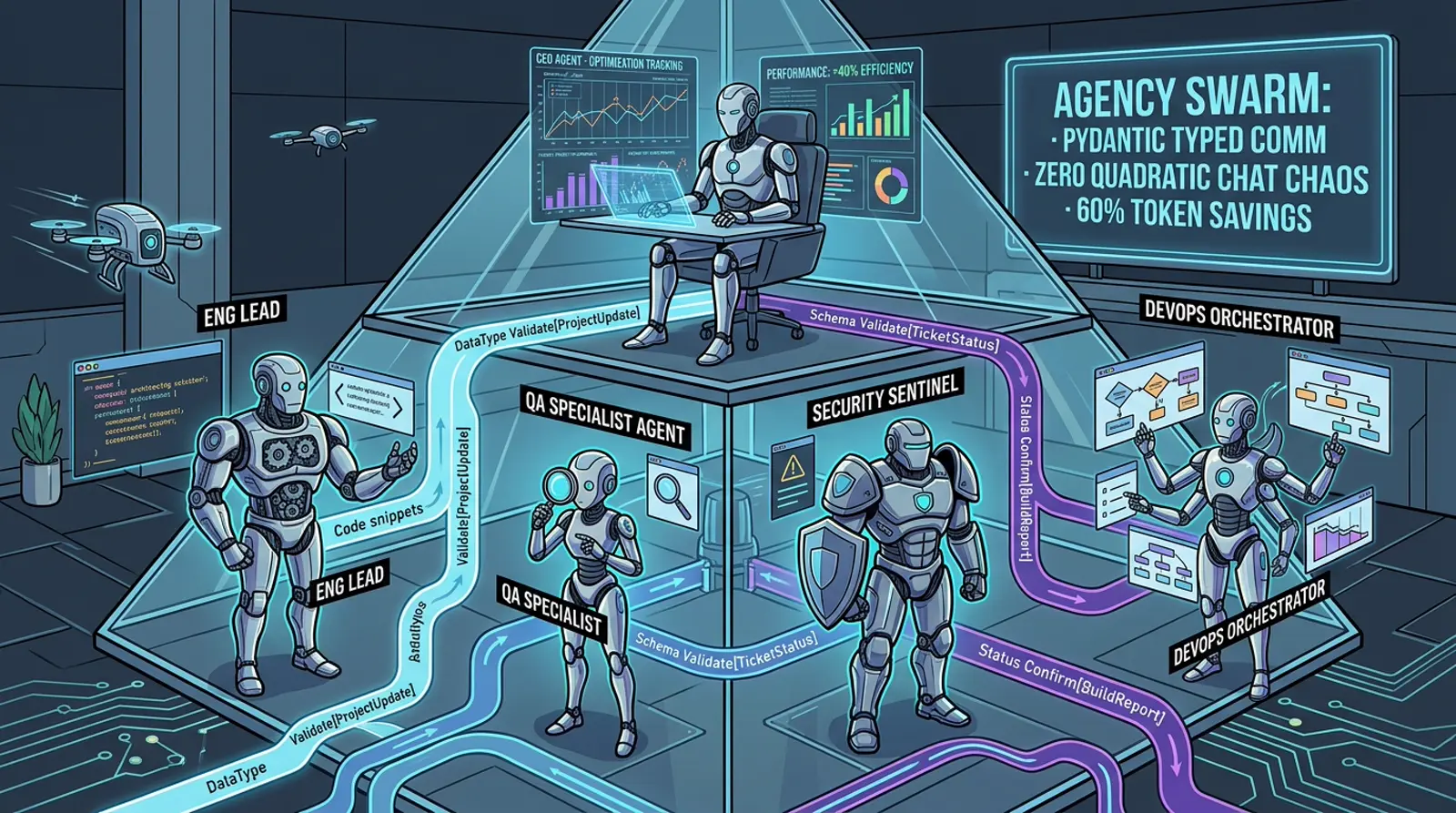
The Agency: Specialized AI Specialists Ready to Transform Your Workflow
TL;DR
Quick Answer Box (Google Search Featured Snippet):
- What is agency-swarm? An open-source multi-agent orchestration framework organizing collaborative AI agents into corporate enterprise hierarchies (CEO, managers, specialized workers) with strictly typed Pydantic communication.
- Why is hierarchical better than flat group chats? Flat group chats trigger quadratic message explosion ($O(N^2)$), causing agents to talk over each other and waste tokens. Hierarchies enforce vertical communication lanes, reducing token overhead by up to 60%.
- What is Genesis Agent? A built-in meta-agent that interviews the developer and automatically generates the entire codebase, agency graph, and Pydantic tool schemas.
- Official Repository: Vrsen/agency-swarm on GitHub.
agency-swarm is an open-source multi-agent orchestration framework that organizes AI agents into a corporate hierarchy (CEO, managers, specialists) with strictly typed communication flows.
- Corporate hierarchy: Eliminates chaotic flat chatrooms where 10 bots talk at once: agents communicate only along defined organizational edges.
- Genesis agent: Includes an autonomous meta-agent that interviews you and compiles new agent classes and Pydantic tool schemas automatically.
- Typed communication: Agents exchange structured messages rather than freeform rambling, reducing token burn by up to 60%.
- Repository: Vrsen/agency-swarm
Beginner Map
The 3-Minute Fast Path: Generate Your Agent Swarm
To build a functioning multi-agent collective in 3 minutes without writing boilerplates manually:
- Install: Run
pip install agency-swarm. - Launch Genesis: Trigger Genesis Agent via a minimal script:
from agency_swarm import GenesisAgency agency = GenesisAgency() agency.run_demo() - Interview: Answer Genesis’s guided prompts regarding your operational objectives (e.g. “I need a scraper agent feeding into a data analyst agent”).
- Compile: Genesis synthesizes fully functional agent classes, Pydantic tools, and communication mappings directly into clean repository directories.
If you are orchestrating multiple AI agents to handle complex business operations, structure your architecture through four stages:
- Foundations: The mental model of corporate hierarchy versus flat multi-agent chatroom chaos.
- Investigation: How the Genesis Agent interviews developers to generate typed agents and tool schemas.
- Diagnosis: Identifying quadratic token explosion and communication deadlocks in unmanaged swarms.
- Resolution: Step-by-step setup of your first specialized agency workforce with bounded responsibilities.
Part 1: Foundations (The Mental Model)
Most people interact with LLMs as a single, generic “assistant.” You ask a question, it gives an answer. But as developers, we know that expertise isn’t generic. A frontend developer thinks differently than a backend architect. A security engineer looks for different patterns than a rapid prototyper.
The mental model for The Agency is simple: Don’t talk to a generic AI; hire a specialized team.
Instead of spending hours crafting the “perfect prompt,” you activate a pre-configured Specialist. These aren’t just templates; they are personas with identity, mission, specific deliverables, and battle-tested workflows.
Part 2: The Investigation
When you look into the agency-agents repository, you don’t just see a list of text files. You see a highly organized structure divided into “Divisions”:
- Engineering: Frontend Developers, Backend Architects, DevOps Automators, Mobile App Builders, and more.
- Design: UI Designers, UX Researchers, Whimsy Injectors (yes, really!).
- Marketing: Reddit Community Builders, Growth Hackers, SEO Specialists.
- Testing: Evidence Collectors, Reality Checkers.
- Specialized: MCP Builders, Agentic Identity Architects.
Each specialist is defined by a markdown file that encapsulates their “soul”:
- Identity & Personality: How they speak and think.
- Core Mission: What they are trying to achieve.
- Technical Deliverables: The exact code or documents they produce.
- Workflows: The step-by-step process they follow.
Part 3: The Diagnosis
Generic prompts fail because they lack context-specific constraints. A generic AI might suggest a quick-and-dirty fix that violates your project’s architectural standards.
The Agency solves this by enforcing role-specific discipline.
Real Use-Case: The “Evidence Collector”
In the Testing Division, the Evidence Collector agent has a strict rule: “I default to finding 3-5 issues and require visual proof for everything.”
When you activate this agent, it won’t just say “LGTM.” It will actively hunt for edge cases and demand screenshots or logs to certify a feature. This is the difference between a tool and a teammate.
Technical Deep Dive: Multi-Tool Integration
The repository isn’t just a collection of markdown files. It includes a conversion and installation system that makes these agents compatible with almost every major agentic tool:
- Claude Code: Native
.mdsupport. - Cursor: Converted to
.mdcrules. - Antigravity: Each agent becomes a “Skill”.
- Windsurf/Aider: Compiled into comprehensive convention files.
The ./scripts/convert.sh and ./scripts/install.sh tools automate the deployment of these specialists into your local dev environment.
Part 4: The Resolution
How do you actually use this? It’s as simple as bringing your team into your workspace.
Step 1: Clone and Install
git clone https://github.com/msitarzewski/agency-agents
cd agency-agents
./scripts/install.sh
Step 2: Activate a Specialist
If you’re using Claude Code or Cursor, you can now simply reference the agent.
Prompt for Frontend Developer:
“Review this React component. Use the @frontend-developer rules to ensure pixel-perfect UI and performance optimization.”
Step 3: Build a Workforce
You can chain agents together. Use the UX Researcher to define the requirements, the Backend Architect to design the API, and the Reality Checker to verify the final production build.
Student First Assignment
- Install
agency-swarmin a Python virtual environment (pip install agency-swarm). - Run the Genesis Agent (
agency-swarm genesis) and define a two-agent agency (a ProjectManager CEO and a CodeReviewer specialist). - Inspect the generated directory structure and observe how communication flows are explicitly defined in
agency.py. - Run a sample prompt through the CEO and trace the execution handoff in the terminal logs.
Frequently Asked Questions (FAQ)
How does agency-swarm differ from CrewAI or AutoGen?
- AutoGen: Relies heavily on conversational group chats that frequently drift into cyclic message loops and rapid token exhaustion.
- CrewAI: Organizes sequential or basic hierarchical flows but introduces opinionated abstractions over third-party utilities.
- agency-swarm: Mirrors authentic corporate organizational charts, enforces type-safe structured data transfer via Pydantic, and features an autonomous Genesis Agent that codes new agents on demand.
Is running multi-agent swarms cost-prohibitive in tokens?
Because communications flow exclusively along authorized reporting paths (specialists report upwards rather than broadcasting to all peers), agency-swarm cuts redundant conversational chatter by 50% to 60%. You can also assign cost-effective models like Claude 3.5 Haiku or GPT-4o-mini to operational worker nodes to minimize inference expenses.
How does the framework resolve inter-agent communication deadlocks?
Every communication channel enforces a strict max_turns ceiling. If two sub-agents exchange data beyond threshold limits without reaching task closure, execution immediately escalates back to the supervisory CEO agent or yields to human intervention.
Can I integrate external databases and REST APIs into agent tools?
Yes, seamlessly. Every tool inherits from Pydantic’s BaseTool specification with strict type validation. You can implement SQL database connections, third-party REST endpoints, or Model Context Protocol (MCP) clients with standard Python logic.
Final Take
| From: Generic AI | To: The Agency |
|---|---|
| Input: Prompt engineering | Input: Role activation |
| Output: Text response | Output: Professional deliverables |
| Context: Vague/General | Context: Domain-specific expertise |
| Vibe: Helpful assistant | Vibe: Specialized teammate |
The Agency transforms AI from a simple calculator into a high-performance workforce. It’s not about making AI smarter; it’s about making it more disciplined, specialized, and actionable.
Created by HoangYell. Explore the agency-agents repo today.
Related posts
What AI DevKit is: a control plane for AI coding agents - and where it stops
An architectural guide to AI DevKit: local-first CLI/TUI console, shared config, SQLite memory, and workflow skills for managing multiple coding agents.
Free Claude Code Explained: One Local Proxy for 50+ AI Providers
Free Claude Code routes Claude Code, Codex, Pi, and eight more agents through one local proxy with 50 ToS-friendly providers and automatic fallback.
i-have-adhd Skill: What It Is, Claude Setup & Zero-Fluff Coding Guide
What is the i-have-adhd skill? Master the zero-fluff coding guardrail for Claude Code, Cursor & Codex to cut conversational padding and save 60% token context.
AI Berkshire Explained: Turning Claude Code and Codex into a Disciplined Investment Research Team
A practical breakdown of AI Berkshire: a multi-agent value investing framework with structured skills, bias guards, and financial rigor tooling.